
Flood Isn’t Just a Coastal Problem
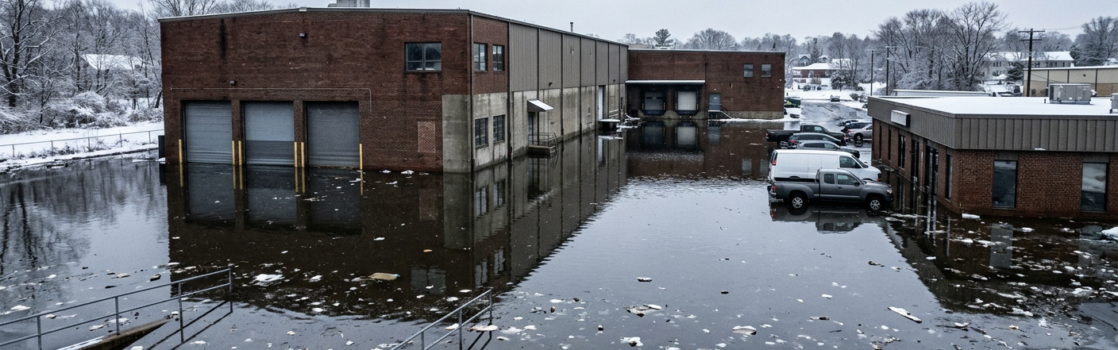
Inland businesses don’t need an ocean to flood. A stalled storm, a creek that rises overnight or a storm drain that can’t keep up can put water through a warehouse or shop floor in a few hours. Many owners only learn after the fact that their property policy doesn’t cover it.
Quick answer: Most commercial property policies exclude flood or cover it only with a limited sublimit. Flood coverage is usually bought separately through the National Flood Insurance Program (NFIP), a private flood policy or an endorsement. Buying it outside a high-risk flood zone is often worth considering, because a large share of flood claims come from those areas.
Does commercial property insurance cover flood?
Usually not, or not fully. Many commercial property forms exclude flood and surface water outright. Others include a flood sublimit that may be far below the value of the building and contents, and some exclude it entirely for locations in high-risk zones. Flood deductibles are often separate and higher than the standard property deductible. Water backup from drains or sewers is yet another coverage, with its own terms.
Am I at risk if I’m not in a flood zone?
Flood maps show relative risk, not the full picture. FEMA reports that about one-third of NFIP claims from 2013 to 2023 came from properties outside high-risk flood areas. Heavy rainfall, flash flooding and overwhelmed drainage can affect properties that have never flooded before.
What are the options for commercial flood coverage?
- NFIP commercial flood: up to $500,000 for a non-residential building and $500,000 for its contents. There is usually a 30-day waiting period before coverage starts, and it does not cover lost business income.
- Private flood: may offer higher limits, business income coverage and different waiting periods, depending on the carrier and location.
- Excess flood: sits above an NFIP policy for buildings and contents worth more than the NFIP limits.
- A flood endorsement or sublimit on your property policy: check how much it actually provides and which locations it covers.
Example: A manufacturer sits near a creek in a moderate-risk zone. Two feet of water reaches the production floor, damaging machinery and inventory worth well over $500,000, and the plant is down for months. NFIP coverage alone would leave the equipment value above the limit and all the lost income uninsured. A layered program of NFIP, excess flood and business income coverage would respond very differently.
What should you do before spring?
- Confirm each location’s flood zone and how close it is to creeks, rivers and low ground.
- Read your property policy’s flood exclusion, sublimit and deductible.
- Check whether business income and extra expense apply to flood.
- Buy coverage well before storm season, because of the waiting period.
- If you have a mortgage on a building in a high-risk zone, confirm your lender’s flood requirements.
Not sure what your property policy says about flood? Hertvik Insurance Group will review your flood exposure location by location. CONTACT TODAY.
General information. Coverage depends on policy wording, carrier and location.